Gianni Colosimo
(1953, Santa Severina, Calabria, Italia). Estudió Historia del Teatro en la Universidad de Turín. Al terminar sus estudios, en 1977 realizó su primera acción performativa en la galería Giorgio Persano de Turín, dando inicio a una carrera artística dominada por la experimentación y la performance.
Desde finales de los años 70, Colosimo se integró en la escena experimental italiana. En 1977 estrenó Berlinguer mon amour en la Academia Albertina de Turín, y al año siguiente presentó la performance Freud Mein Freund en la galería de Giorgio Persano. Trasladado a Roma en 1978, participó activamente en espacios como el Beat 72 y el Spazio Uno.
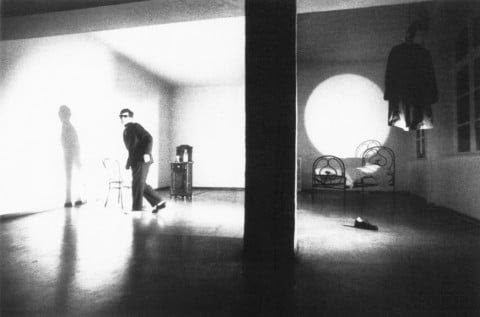
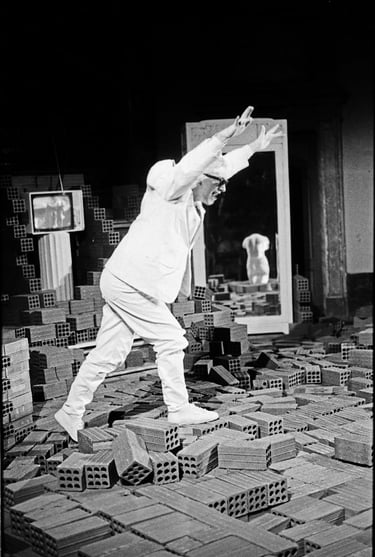
En 1981 presentó en la Galería Nacional de Arte Moderno de Roma la instalación-performance Il grande sonno della trapezista, donde pagó al público por asistir, invirtiendo los roles tradicionales de artista y espectador.
A lo largo de los años 80 continuó explorando medios conceptuales. En 1984 presentó Nebbia di latte (Mist of Milk) en el Castello di Rivoli (Turín), y en 1990 realizó la pieza Gli amori dei sette peccati. En 1982 defendió una tesis sobre Yves Klein y el “Teatro del Vacío”, afianzando su interés por la estética conceptual. A partir de 1990 abandonó temporalmente la performance para dedicarse a la pintura, inspirada en el arte primitivo, e inició una serie de obras con billetes de dólar. En 1997 retornó a la performance con Nutella Gutenberg, representada en Turín. Casi al mismo tiempo, fundó la asociación cultural Infinito LTD, con la que organizó el festival performativo “Torino Chiama: Infinito Ltd” (2000-2001), al tiempo que abría y dirigía la Galleria Infinito LTD hasta 2004.
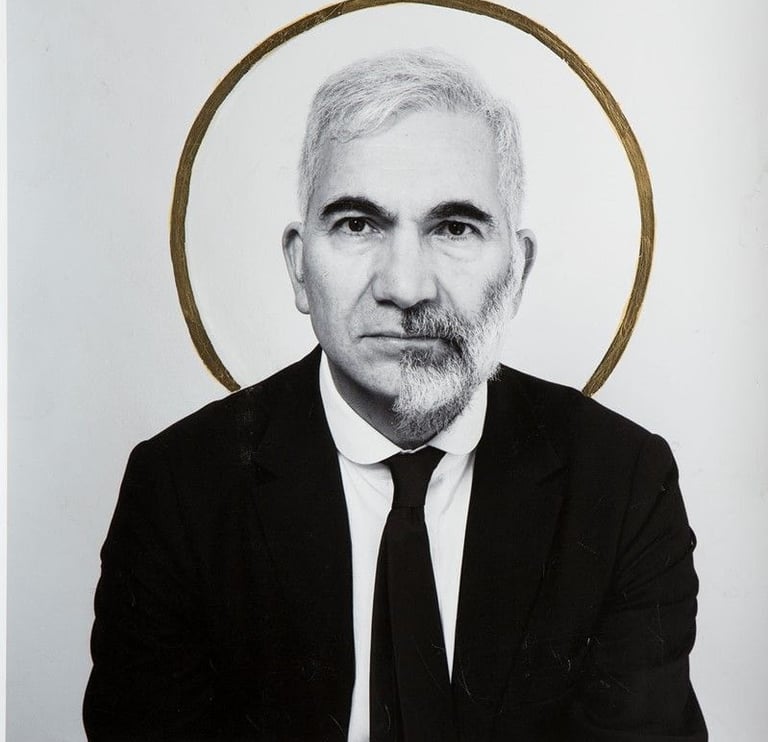
Gianni Colosimo was born in 1953 in Santa Severina (Province of Crotone, Calabria, Italy). He studied Theatre History at the University of Turin. Upon completing his studies, in 1977 he staged his first performance at the Giorgio Persano Gallery in Turin, thus inaugurating an artistic career marked by experimentation and performance. From the late 1970s onwards, Colosimo became an integral figure in the Italian experimental art scene. In 1977 he premiered Berlinguer mon amour at the Albertina Academy in Turin, and the following year he presented the performance Freud Mein Freund at the Giorgio Persano Gallery. After moving to Rome in 1978, he became involved in venues such as Beat 72 and Spazio Uno. In 1981, at the National Gallery of Modern Art in Rome, he presented the installation-performance Il grande sonno della trapezista, in which he paid the public to attend, thus inverting the conventional roles of artist and spectator.
Throughout the 1980s, he continued to explore conceptual practices. In 1984 he presented Nebbia di latte (Mist of Milk) at the Castello di Rivoli (Turin), and in 1990 he staged Gli amori dei sette peccati. In 1982 he defended a thesis on Yves Klein and the “Theatre of the Void”, thereby consolidating his interest in conceptual aesthetics.
From 1990 onwards, Colosimo temporarily left performance art to dedicate himself to painting, inspired by primitive art, and initiated a series of works employing U.S. dollar bills. In 1997 he returned to performance with Nutella Gutenberg, staged in Turin. Almost simultaneously, he founded the cultural association Infinito LTD, with which he organized the performance festival “Torino Chiama: Infinito Ltd” (2000–2001), while also opening and directing the Infinito LTD Gallery until 2004.
After 2005 Colosimo resumed his large-scale visual career. In 2006 he inaugurated at the Galleria Pack in Milan the installation Wallpaper: il vortice del desiderio è privo d’orizzonte, covering the walls and floor with more than 100,000 U.S. dollar bills. This work, which interrogates the fetishism of money and its artistic value, received wide critical attention and was reprised in 2008 at Motelsalieri Gallery in Rome under the title Senza scarpe in un baratro di errori. That same year he participated in the International Biennale of Sculpture in Carrara (2008), presenting the piece Ai caduti per l’Arte. Between 2009 and 2010 he produced Il silenzio incestuoso della mia ombra ferita, an exhibition dispersed across the pages of the art journals Exibart, Mousse, Nero, and Artforum.
During the 2010s, Colosimo developed international projects. In 2011 he co-produced with the Centre Pompidou-Metz the itinerant exhibition L’arte contemporanea raccontata ai bambini (Contemporary Art Explained to Children), based on his “Magicaboola” project. That year he also took part in the II Biennale of Alessandria with the installation Don Yuan: c’è del latte e del miele sotto la tua lingua cinese, conceived together with the artist Luisa Bruni. In 2012 this project was expanded at La Sucrière in Lyon with thirty additional works, and Colosimo also presented the performance L’orso e il toro: un amplesso misericordioso at Sponge Arte Contemporanea in Turin.
In 2013 he exhibited L’arcana profezia delle sette vacche tibetane at Palazzo Binelli in Carrara (within the Marble Week festival) and later at Baudoin Lebon Gallery in Paris. In 2014 he staged two solo exhibitions in Turin: in June at Riccardo Costantini Contemporary (new works) and in November at The Bank (“Starring Colosimo”), as well as participating in the group exhibition “Surprise” (GAM Torino), where he revisited his Grande sonno della trapezista of 1981. That year, his work Wallpaper was celebrated in the exhibition “Shit & Die” (Palazzo Cavour, Turin), curated by Maurizio Cattelan, in which artist Eric Doeringer covered the main staircase with dollar bills in homage to Colosimo’s piece.
In 2015 he presented his first solo show in Rome, Resurrezione, at Galleria Giacomo Guidi, a project centred on money and economics, approached with mordant humour. More recently, the exhibition Ammutinamento (2019) at Riccardo Costantini Contemporary in Turin stands out. In 2024 he married Luisa Bruni; together they launched artistic collaborations, such as the joint organization of the exhibition “Don Yuan – There is milk and honey under your tongue” in Turin, later shown in Paris.
Colosimo belongs to the tradition of conceptual art and critical performance. From the outset he reinterpreted the aesthetics of Yves Klein, Piero Manzoni, and Situationism, questioning the “society of the spectacle” and artistic conventions. His performances (such as paying the audience to attend) inverted traditional roles and highlighted the artist-spectator relationship. Irony and provocation pervade his oeuvre: he employs quotations, parody, and appropriation from popular culture and modern art, intermingling tragedy with comedy.
A recurrent theme in his production is money and its social contradictions. Colosimo probes the monetary value of art, market dynamics, and global economic paradoxes, always from a critical and demystifying perspective. For instance, his installation Wallpaper turns the dollar bill into a decorative material, thereby questioning the essence of artistic value. Other works and actions satirize financial institutions (such as the Lehman Brothers monument in Resurrezione, 2015) or explore political iconographies (his series inspired by contemporary China, as recently displayed in Don Yuan). His style merges live performance with installation and spatial intervention, while maintaining a Brechtian sense of estrangement: provoking critical reflection without didacticism.
He also participated in important group exhibitions: Una generazione postmoderna (1982, Palazzo delle Esposizioni, Rome), the Carrara Biennales (2008, 2009), the Alessandria Biennale (2011), the Venice Biennale 2011 (Italian Pavilion), and curatorial projects such as Shit & Die (Turin, 2014/15). He has also exhibited at international art fairs such as ARCO (Madrid) and Artissima (Turin).
Colosimo has collaborated with cultural institutions and artists throughout his career. His alliance with the Centre Pompidou-Metz (France) produced his children’s exhibition L’arte contemporanea raccontata ai bambini (2011), later expanded in Lyon. He has also worked with curators such as Patrick Amine (Pompidou) and Sabrina Raffaghello (Biennale of Alessandria). In the late 1990s he also acted as patron: through Infinito Ltd he organized the festival Torino Chiama (2000–2001) and founded the Infinito LTD Gallery (2003–2004) to support emerging artists.
Artistically, Colosimo collaborates with his wife Luisa Bruni (a contemporary jewellery artist). They married in 2023 and have since presented joint projects such as “Don Yuan”, an immersive installation inspired by modern Chinese iconography. He has also influenced later artists, for example Eric Doeringer, who reinterpreted Wallpaper in his homage for the exhibition Shit & Die (2014).
Colosimo has evolved from the performance art of the 1970s towards interdisciplinary installations and projects, without ever relinquishing his critical edge. His early work, linked to postmodernism and the Italian avant-garde, involved actions in theatrical spaces and galleries. Over time he embraced sculpture, installation, and conceptual interventions, always infused with irony and socio-political reflection. He has broadened his audiences (including children) and media (painting, objects, multimedia performance), while maintaining his constant questioning of artistic rules and capitalism. His most recent works continue to explore the dialectic of money and art, an ironic analysis of global economics, and the provocation of critical doubt in the viewer.
LAVIO Art Gallery
Murcia - Shanghai
Contact:
(+0034) 628990629
lavioartgallery@gmail.com